
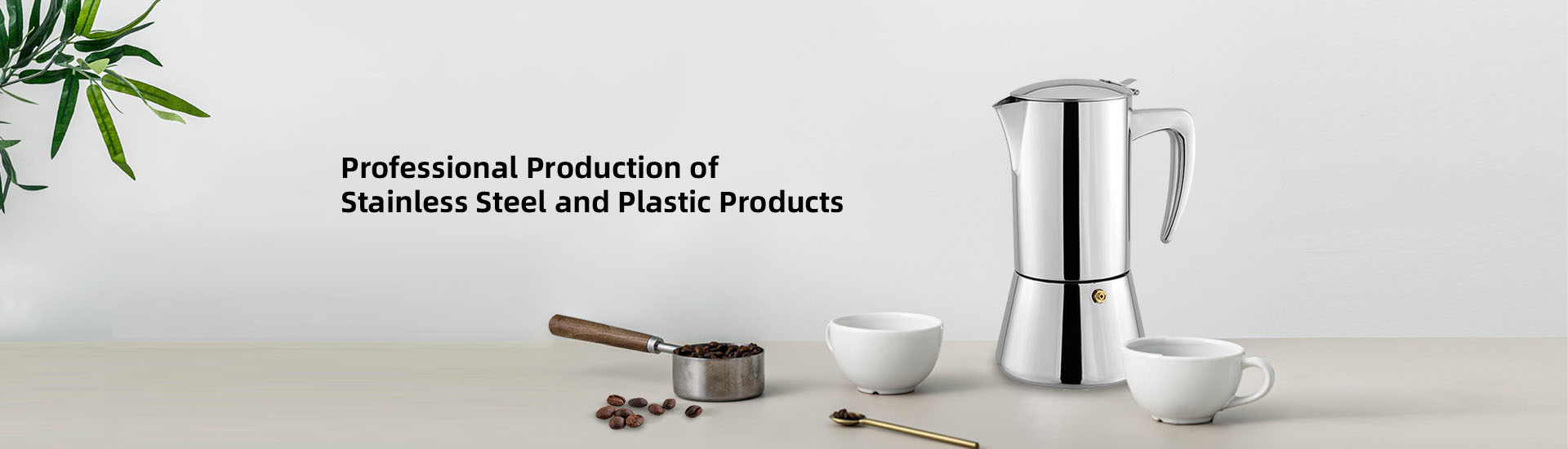
The manufacturing process of stainless steel kitchen products involves multiple stages, from material selection and metal forming to surface finishing, assembly, and quality inspection. A reliable stainless steel kitchenware manufacturer must control every production step to ensure product durability, appearance, safety, and consistency during mass production.
Stainless steel is widely used in food-contact applications because of its corrosion resistance, hygiene performance, and easy cleaning characteristics. Common food-contact grades include 304 and 316 stainless steel, with 304 often used for general kitchen applications due to its balance of performance and cost. :contentReference[oaicite:0]{index=0}
For manufacturers, stable production requires not only advanced equipment but also strict process management from raw material to finished products.
The first step of stainless steel kitchenware manufacturing is selecting suitable materials.
Common stainless steel grades include:
| Material Grade | Characteristics | Common Applications |
|---|---|---|
| 304 Stainless Steel | Good corrosion resistance and durability | Kitchen utensils, cookware, food containers |
| 316 Stainless Steel | Higher resistance to chloride environments | Premium and special applications |
| 430 Stainless Steel | Magnetic and cost-effective | Selected kitchen accessories |
304 stainless steel usually contains approximately 18% chromium and 8% nickel, providing reliable corrosion resistance for many kitchen applications. 316 stainless steel includes molybdenum, which improves corrosion resistance in environments with higher salt exposure. :contentReference[oaicite:1]{index=1}
At SELLWELL, material selection is managed according to product requirements, application scenarios, and market standards to ensure stable product performance.
After material preparation, stainless steel sheets or components enter the forming process.
The typical manufacturing process includes:
Stainless steel cutting
Metal stamping or deep drawing
Welding and joining
Edge trimming
Surface polishing
Component assembly
Different products require different forming methods. For example, coffee makers, kettles, storage containers, and kitchen utensils may require different structures, thicknesses, and processing techniques.
A professional stainless steel kitchenware manufacturer needs experienced engineering teams to optimize product design before mass production.
Surface treatment is an important step that affects both appearance and user experience.
Common finishing methods include:
Mirror polishing
Satin finishing
Brushed finishing
PVD coating
Surface finishing helps improve:
Product appearance
Scratch resistance
Cleaning performance
Market positioning
During production, manufacturers need to control polishing consistency because uneven finishing can affect the final product quality.
Many modern kitchen products combine stainless steel with plastic components.
Products such as kitchen organizers, coffee accessories, and storage solutions may require:
Plastic injection molding
Component matching
Assembly testing
Function verification
Having both stainless steel processing and plastic manufacturing capability helps improve production coordination and reduces supply chain complexity.
SELLWELL combines stainless steel manufacturing and plastic injection capabilities, allowing different product components to be developed and produced within an integrated manufacturing system. :contentReference[oaicite:2]{index=2}
Quality inspection should not only happen at the end of production. A reliable manufacturing process includes checkpoints throughout production.
| Production Stage | Quality Control Focus |
|---|---|
| Raw material inspection | Verify stainless steel grade and specifications |
| Metal forming | Check dimensions and structure |
| Welding process | Ensure connection strength |
| Polishing | Inspect surface consistency |
| Assembly | Confirm component fitting |
| Final inspection | Check appearance and function |
SELLWELL has established quality management systems and has passed ISO 9001:2015 certification, together with factory audits including SMETA, BSCI, GMP, and SCAN. :contentReference[oaicite:3]{index=3}
For customized kitchen products, OEM and ODM capabilities are important.
A complete development process usually includes:
Product concept review
Engineering evaluation
Prototype development
Sample confirmation
Production preparation
Bulk manufacturing
Final inspection and shipment
OEM projects may require customized structures, materials, logos, or packaging, while ODM projects often involve modifying existing product designs according to market requirements.
A manufacturer with complete development capability can provide better support throughout the project lifecycle.
Mass production requires more than producing a successful sample.
Before starting bulk production, manufacturers should evaluate:
Production capacity
Material supply stability
Quality consistency
Lead time management
Packaging requirements
A professional factory should maintain the same product standards from the first unit to the final production batch.
Kitchenware products sold internationally must meet different market requirements.
Important considerations include:
Food contact material safety
Product testing requirements
Packaging standards
Shipping documentation
Customer-specific compliance needs
The European Union requires food-contact materials to comply with safety requirements under Regulation EC No 1935/2004, ensuring materials do not transfer substances into food at levels that may affect consumer health. :contentReference[oaicite:4]{index=4}
The manufacturing of stainless steel kitchen products is a complete process combining material knowledge, metal processing, quality control, customization capability, and export experience.
SELLWELL focuses on stainless steel and household product manufacturing, supporting OEM and ODM projects through integrated production capabilities, quality management, and international supply experience.

 WhatsApp:
 Phone:
 Contact Now