
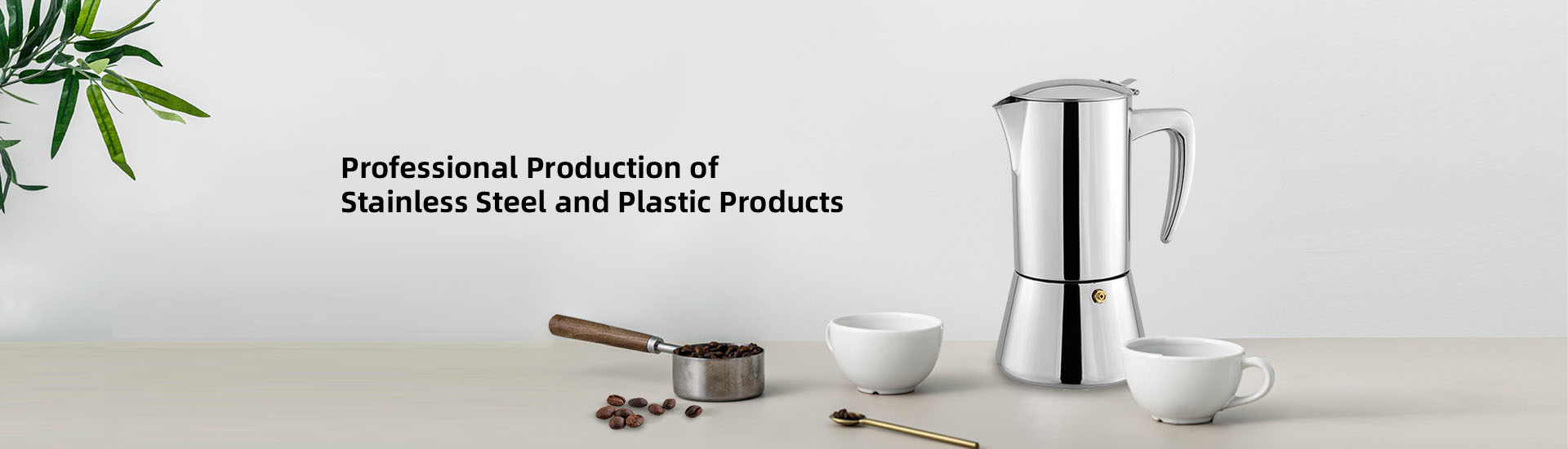
Stainless steel coffee makers are generally better for long-term use because they provide stronger durability, better heat resistance, and higher product value, while plastic coffee makers offer lightweight and cost advantages.
The main difference between stainless steel and plastic coffee makers is the material performance and product positioning.
A stainless steel coffee maker uses metal construction to provide strength, durability, and a premium appearance. It is commonly selected for products that require long service life, frequent use, and higher perceived quality.
A plastic coffee maker uses engineered plastic materials to achieve lightweight design, flexible structures, and efficient production. Plastic solutions are often used when cost control, portability, and design variety are important.
For manufacturers, material selection affects product durability, production processes, market positioning, and customer expectations.
Stainless steel is widely used in coffee products because of its reliable physical properties.
Key advantages include:
Strong resistance to impact and deformation
Better corrosion resistance
Higher durability during repeated use
Premium metallic appearance
Easier long-term maintenance
Coffee makers made with stainless steel are suitable for environments requiring frequent operation, including homes, offices, hotels, and commercial coffee areas.
From a manufacturing perspective, durability depends on:
Stainless steel material quality
Structural design
Welding accuracy
Surface treatment
Assembly consistency
Plastic coffee makers provide benefits in flexibility, weight, and production efficiency.
Their advantages include:
Lightweight structure
Lower production cost
Flexible design possibilities
Easier color customization
Efficient mass production
Plastic materials allow manufacturers to create complex shapes and ergonomic designs that may be more difficult with metal structures.
For products targeting affordable markets or portable applications, plastic coffee makers can provide practical solutions.
The performance difference between stainless steel and plastic can be evaluated through several factors.
| Comparison Factor | Stainless Steel Coffee Maker | Plastic Coffee Maker |
|---|---|---|
| Durability | Excellent long-term performance | Depends on material quality |
| Heat Resistance | Higher heat tolerance | Varies by plastic type |
| Impact Resistance | Strong structural strength | Lightweight but may be less rigid |
| Appearance | Premium metal finish | Flexible colors and designs |
| Maintenance | Easy long-term care | Requires suitable cleaning methods |
| Production Cost | Higher material and processing cost | More cost-efficient |
For long-term household and commercial use, stainless steel generally provides stronger durability advantages.
Heat performance is an important factor in coffee maker design.
Stainless steel provides:
Better temperature stability
Strong resistance to repeated heating cycles
Reliable performance in hot beverage applications
Plastic performance depends on the specific material type. Food-grade heat-resistant plastics can provide safe performance, but they generally require careful material selection and quality control.
For coffee products exposed to frequent heat, stainless steel often provides greater reliability.
Material choice strongly influences customer perception.
Stainless steel products are often associated with:
Premium quality
Professional appearance
Longer service life
Higher durability expectations
Plastic products are often valued for:
Affordable pricing
Lightweight handling
Modern design flexibility
Convenient usage
The right material depends on target customers and market positioning.
Commercial environments usually require products that can handle frequent operation.
Stainless steel coffee makers are suitable for:
Hotels
Restaurants
Cafes
Office coffee stations
Their durability helps reduce replacement frequency and supports long-term use.
Plastic coffee makers may be suitable for:
Travel products
Personal coffee solutions
Entry-level markets
Lightweight product categories
Yes. Many coffee products combine both materials to balance performance and cost.
Common combinations include:
Stainless steel brewing components with plastic handles
Metal structures with plastic ergonomic parts
Stainless steel filters with plastic outer components
This hybrid approach allows manufacturers to optimize durability, user comfort, design flexibility, and production efficiency.
Material alone does not determine product quality. Manufacturing capability plays an important role.
Important production capabilities include:
Material processing expertise
Product structure development
Surface finishing
Component assembly
Quality inspection
OEM and ODM support
For stainless steel coffee makers, processes such as stamping, welding, polishing, and finishing influence product appearance and reliability.
The choice between stainless steel and plastic depends on product goals.
Stainless steel coffee makers are better suited for brands focusing on durability, premium positioning, and long-term performance.
Plastic coffee makers are suitable for brands prioritizing lightweight design, cost efficiency, and flexible product styling.
For manufacturers developing coffee product solutions, selecting the right material helps create products that meet market expectations and provide lasting value.
For long-term use, stainless steel coffee makers provide stronger advantages through durability, heat resistance, and premium product perception. Plastic coffee makers remain valuable for lightweight, cost-effective, and flexible product designs.
Understanding material characteristics helps brands and manufacturers select coffee maker solutions that match different applications, customer needs, and market strategies.

 WhatsApp:
 Phone:
 Contact Now