
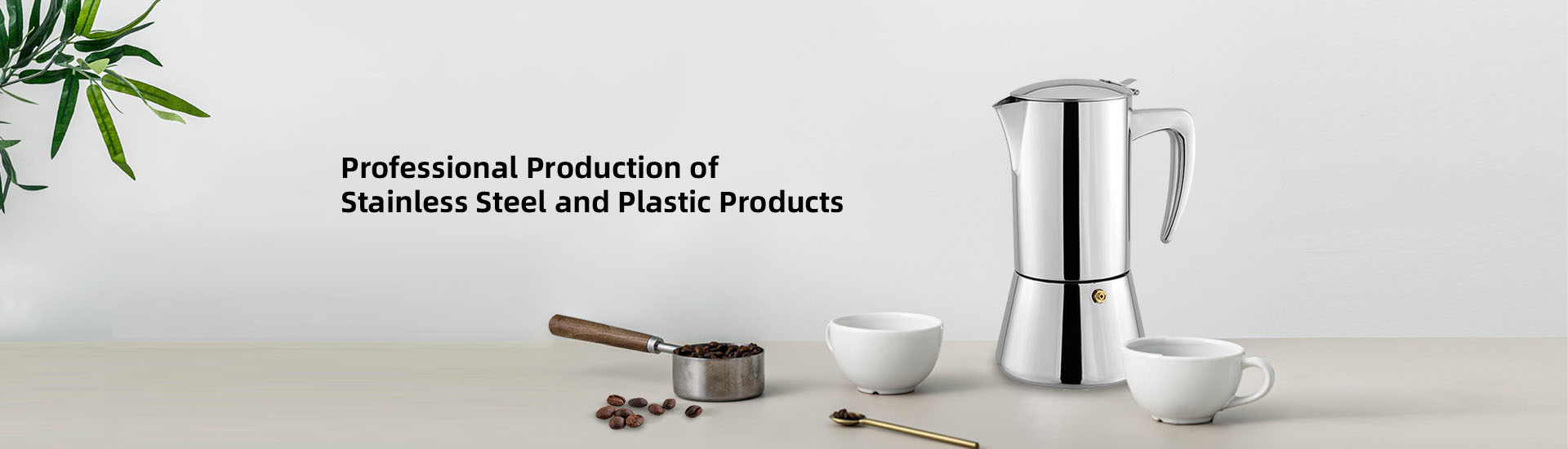
Pour over coffee maker products continue to attract steady demand because they answer two important needs at the same time: better flavor control and a cleaner product story for the market. Buyers are not only looking at brewing results. They are also checking whether a product can fit premium retail positioning, private label development, and long-term supply planning. SELLWELL’s coffee appliance background gives this category stronger production support, with a factory established in 1991, more than 500 employees, a 60,000 square meter site, and in-house stainless steel milling and plastic injection capacity.
A pour over coffee maker appeals to buyers because it highlights brewing visibility, simple structure, and stable user experience. In coffee extraction, temperature control remains a key factor. Industry references from the Specialty Coffee Association place effective brewing in the 90°C to 96°C range, with 92°C often treated as an important minimum benchmark in brewer evaluation. That helps explain why pour over related equipment is often positioned as a more quality-focused category rather than only a low-cost appliance line.
For a sourcing team, the difference between a manufacturer and a trader becomes very clear in pour over coffee maker projects. A trader may provide product access, but a manufacturer controls material selection, mold accuracy, heating system matching, assembly consistency, and batch correction speed. SELLWELL presents itself as a manufacturing enterprise with integrated production resources, which is important for coffee makers because brewing performance depends on coordinated heating, water flow, and part stability. When one shipment must match the sample, factory control matters more than catalog variety.
In this segment, OEM and ODM work is not limited to logo printing or carton changes. A proper project normally includes technical review, prototype validation, heating element configuration, flow rate calibration, brew temperature testing, safety compliance verification, and mass production confirmation. SELLWELL’s published coffee maker development content shows this kind of structured process, along with customization options such as heating wattage, control panel design, automatic shut-off timing, thermal carafe integration, voltage adaptation, and packaging. This gives buyers more flexibility when building a differentiated line for wholesale or project sourcing.
Bulk supply for pour over coffee maker programs should never be judged by sample appearance alone. Buyers need to confirm whether the supplier can keep brew performance stable across repeated production runs. Heating consistency, water channel accuracy, leak resistance, and assembly tolerance all affect the final user experience. SELLWELL’s own coffee maker content emphasizes stable heating calibration and batch traceability in bulk supply environments, which are practical checkpoints for buyers comparing suppliers.
A reliable manufacturing process overview should cover raw material inspection, plastic injection accuracy, stainless steel part forming, heating system installation, flow channel assembly, electrical testing, leakage inspection, brewing trials, and final packaging review. For pour over style products, quality control checkpoints should focus on water distribution uniformity, temperature rise stability, reservoir sealing, switch response, and finished product durability. These details reduce complaint risk after shipment and support more stable reorder programs. SELLWELL’s coffee maker articles repeatedly connect brew quality with engineering control and factory testing, which is the right logic for this product category.
Material standards used in coffee appliances must support food contact safety, heat resistance, and electrical reliability. Buyers should review plastic grade suitability, stainless steel part consistency, heating system protection, voltage version matching, and labeling requirements for destination markets. SELLWELL states that it handles OEM and ODM projects for worldwide customers and has passed ISO 9001:2015 as well as audits such as SMETA, BSCI, GMP, and SCAN. Those points strengthen export market compliance discussions and help buyers evaluate whether the factory can support formal market entry requirements.
| Item | What to verify |
|---|---|
| Product structure | Pouring flow, reservoir design, filter fit |
| Heating performance | Brewing temperature stability |
| Material review | Food contact safety and heat resistance |
| QC plan | Leakage test, electrical test, brew test |
| OEM details | Logo, voltage, packaging, instructions |
| Compliance file | Audit records and certification readiness |
For buyers evaluating why pour over coffee maker is still a strong category, the answer is not only about brewing style. It is also about product positioning, engineering simplicity, premium potential, and supply chain control. SELLWELL combines long manufacturing history, integrated production capacity, structured OEM and ODM development, and export-oriented factory management. That combination helps turn a simple coffee product into a more dependable and scalable sourcing program.

 WhatsApp:
 Phone:
 Contact Now