
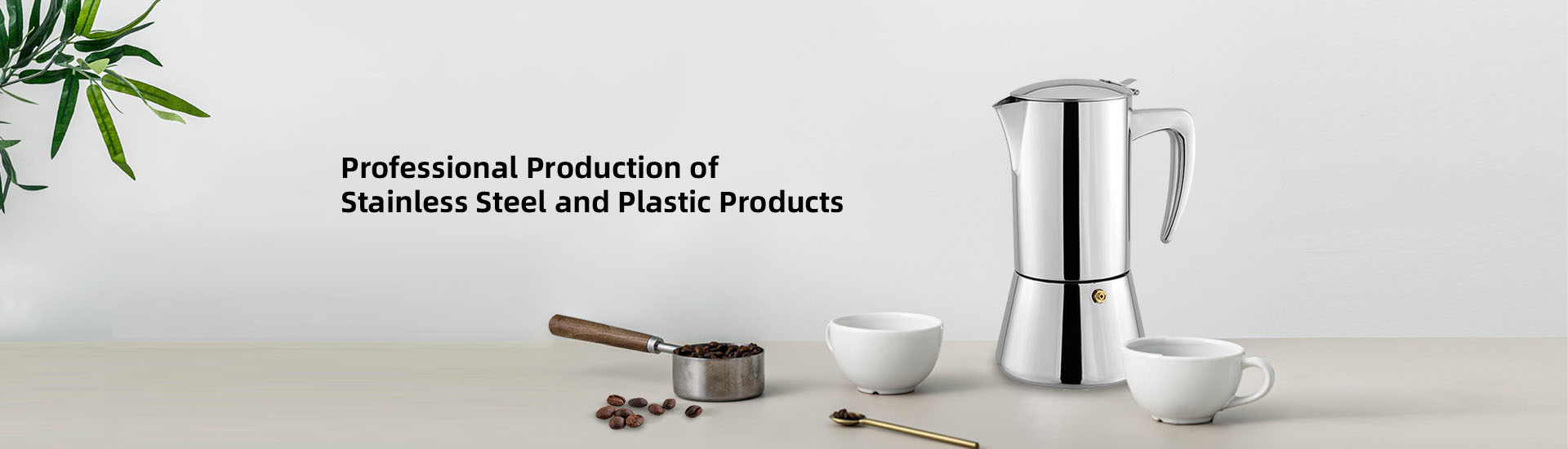
Evaluating the quality of stainless steel kitchenware requires more than checking the appearance of finished products. Material grade, manufacturing process, surface treatment, structural strength, quality control, and compliance standards all determine whether kitchen products can maintain stable performance during long-term use.
A reliable stainless steel kitchenware manufacturer should control the entire process from raw material inspection to final shipment, ensuring that every production batch meets the same quality requirements.
The material is the foundation of stainless steel kitchenware quality. Different stainless steel grades provide different levels of corrosion resistance, durability, and cost performance.
Common stainless steel grades include:
| Material Grade | Composition | Typical Application |
|---|---|---|
| 304 Stainless Steel | Around 18% chromium and 8% nickel | General kitchenware and food contact products |
| 316 Stainless Steel | Contains molybdenum for higher corrosion resistance | Premium applications and high-salt environments |
| 430 Stainless Steel | Lower nickel content | Cost-sensitive products and decorative applications |
304 stainless steel, often known as 18/8 stainless steel, is widely used in food-related applications because chromium creates a protective passive layer that improves corrosion resistance. 316 stainless steel adds molybdenum, which provides better resistance against chloride environments. :contentReference[oaicite:0]{index=0}
When selecting a supplier, confirm whether the stated material grade matches the actual production material rather than relying only on product descriptions.
A quality kitchenware product depends on controlled manufacturing processes.
For stainless steel products, the production process usually includes:
Raw material inspection
Cutting and forming
Welding and assembly
Surface polishing
Component installation
Final inspection
Packaging
Each step influences the final product quality.
For example, poor forming control may create uneven structures, while inconsistent polishing can affect appearance and cleaning performance. A professional manufacturer should have experienced technicians and stable production equipment to maintain consistency during bulk production.
SELLWELL integrates stainless steel processing, plastic injection molding, assembly, and product development capabilities, allowing different manufacturing stages to be managed within an organized production system. :contentReference[oaicite:1]{index=1}
Surface treatment is an important quality indicator for stainless steel kitchenware.
Key inspection points include:
Smooth surface without scratches
Consistent polishing effect
Clean welding areas
Accurate product dimensions
Proper edge treatment
A well-finished product improves both appearance and user experience.
For kitchen products, edges should be carefully processed because sharp or uneven areas may affect safety and usability.
Appearance alone cannot determine product quality. Kitchenware should also pass functional inspections.
Quality checks may include:
| Inspection Item | Purpose |
|---|---|
| Dimension testing | Ensure production consistency |
| Assembly inspection | Confirm component matching |
| Strength testing | Verify product durability |
| Function testing | Ensure proper operation |
| Appearance inspection | Maintain market standards |
For products such as coffee makers, kettles, storage containers, and kitchen tools, functional testing is especially important because small structural problems can affect daily use.
A reliable supplier should have quality control throughout the complete manufacturing process.
Important checkpoints include:
Incoming material inspection
Production process monitoring
Semi-finished product inspection
Finished product testing
Packaging inspection
SELLWELL has achieved ISO 9001:2015 certification and has completed factory audits including SMETA, BSCI, GMP, and SCAN, demonstrating established quality management practices. :contentReference[oaicite:2]{index=2}
A strong quality system helps maintain consistency between approved samples and mass production orders.
For customized kitchenware projects, manufacturing experience is an important evaluation factor.
A capable OEM supplier should support:
Product design review
Material selection
Prototype development
Sample approval
Production preparation
Bulk manufacturing
Quality inspection
Compared with a trader, a direct manufacturer can communicate more efficiently with engineering and production teams. This helps solve issues related to structure, materials, packaging, and production adjustments.
SELLWELL provides OEM and ODM services for stainless steel and household products, supporting customized product development and large-volume manufacturing requirements. :contentReference[oaicite:3]{index=3}
Kitchenware products entering international markets need to meet different regulations.
Important considerations include:
Food contact material requirements
Product testing
Packaging standards
Labeling requirements
Shipment documentation
The European Union requires food-contact materials to meet safety requirements under Regulation EC No 1935/2004, ensuring materials do not release substances that may affect consumer health. :contentReference[oaicite:4]{index=4}
A supplier with export experience can help reduce compliance risks and improve delivery reliability.
Before selecting a stainless steel kitchenware supplier, review:
| Category | Evaluation Question |
|---|---|
| Material | Is the stainless steel grade clearly confirmed? |
| Production | Does the factory control key processes? |
| Quality | Are inspection standards established? |
| Customization | Can OEM and ODM requirements be supported? |
| Capacity | Can bulk orders maintain stable quality? |
| Compliance | Can export requirements be managed? |
The quality of stainless steel kitchenware comes from the combination of material control, production technology, inspection systems, and manufacturing experience.
A reliable supplier should not only provide finished products but also demonstrate the ability to control every stage from raw materials to shipment.
With stainless steel processing, plastic injection capabilities, OEM and ODM experience, and established quality management systems, SELLWELL supports customers with consistent kitchenware manufacturing solutions for global markets.

 WhatsApp:
 Phone:
 Contact Now