
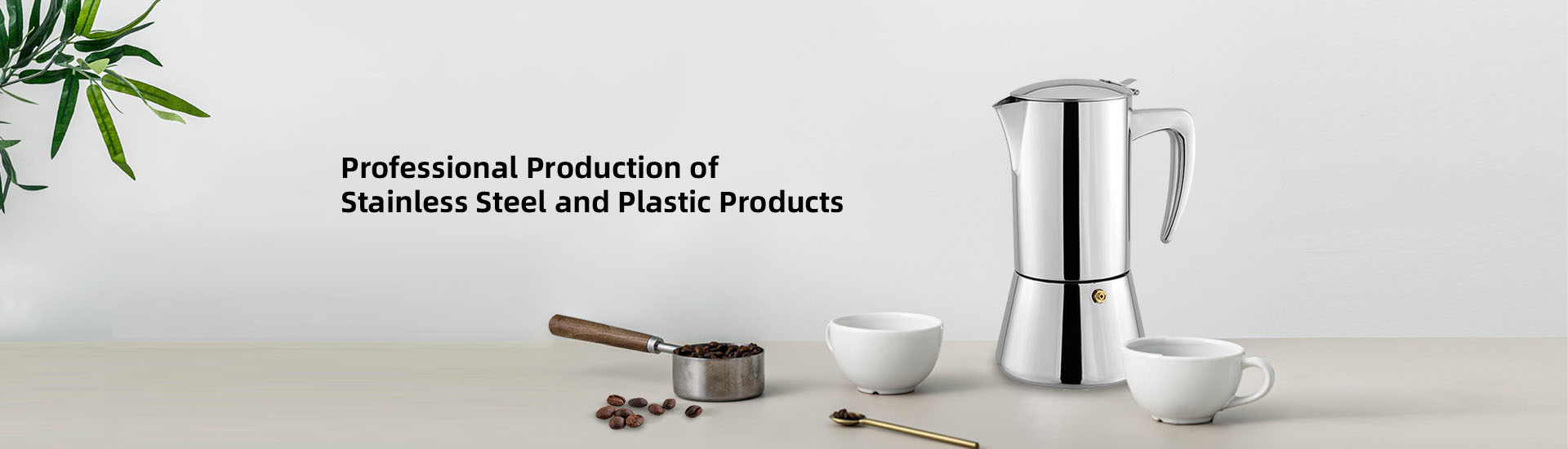
The material selection of stainless steel kitchen products directly affects durability, corrosion resistance, appearance, and compliance with food-contact requirements. A professional stainless steel kitchenware manufacturer must select suitable stainless steel grades based on product function, usage environment, target market, and production requirements.
Common stainless steel materials used in kitchen products include 304, 316, and 430 stainless steel. Among them, 304 stainless steel is one of the most widely used grades for food-related applications because of its balance between corrosion resistance, formability, and cost efficiency. :contentReference[oaicite:0]{index=0}
For OEM and ODM kitchenware production, choosing the correct material is the first step toward stable quality and long-term product performance.
304 stainless steel is widely used in kitchen products because it provides good corrosion resistance and excellent processing performance.
The typical composition of 304 stainless steel includes approximately:
| Material Element | Approximate Content |
|---|---|
| Chromium | 18% |
| Nickel | 8% |
| Iron and other elements | Balance |
The chromium content creates a passive protective layer on the surface, while nickel improves corrosion resistance and formability. This makes 304 stainless steel suitable for products such as kitchen utensils, coffee makers, storage containers, and food-contact equipment. :contentReference[oaicite:1]{index=1}
SELLWELL uses stainless steel materials according to product requirements and market applications, supporting customized kitchen products through professional manufacturing processes.
316 stainless steel is another common material used in premium kitchen and food-related applications.
The main difference between 304 and 316 stainless steel is the addition of molybdenum in 316 stainless steel, which improves resistance to corrosion in more demanding environments.
| Material | Main Feature | Suitable Application |
|---|---|---|
| 304 Stainless Steel | Balanced performance and cost | Daily kitchen products |
| 316 Stainless Steel | Higher corrosion resistance | Premium and special environments |
| 430 Stainless Steel | Cost-effective option | Selected kitchen accessories |
316 stainless steel typically contains chromium, nickel, and molybdenum, providing better resistance against localized corrosion compared with 304. :contentReference[oaicite:2]{index=2}
For products exposed to higher humidity, salt, or demanding environments, selecting the correct stainless steel grade helps improve product lifespan.
430 stainless steel belongs to the ferritic stainless steel family and is often selected when cost control and appearance requirements are important.
Its characteristics include:
Good oxidation resistance
Magnetic properties
Lower material cost
Suitable surface finishing performance
430 stainless steel can be used for selected kitchen accessories and household products where extremely high corrosion resistance is not the primary requirement.
The final material choice should always consider product application rather than simply selecting the lowest-cost option.
A reliable kitchenware manufacturer evaluates multiple factors before production.
Important considerations include:
| Evaluation Factor | Impact on Material Selection |
|---|---|
| Product application | Determines corrosion resistance needs |
| Food contact requirements | Affects material compliance |
| Production process | Influences forming and welding |
| Surface finish | Determines appearance quality |
| Target market | Affects required standards |
For example, a stainless steel coffee maker may require different structural and finishing requirements compared with a storage container or Kitchen Utensil Set.
Material quality alone does not guarantee a high-quality product. The manufacturing process also affects the final result.
A professional stainless steel kitchenware production process includes:
Raw material inspection
Cutting and forming
Welding and assembly
Polishing and surface treatment
Component installation
Final quality inspection
During production, manufacturers need to control:
Material thickness
Forming accuracy
Welding quality
Surface consistency
Product dimensions
SELLWELL integrates stainless steel processing, plastic injection molding, assembly, and product development capabilities to support complete kitchenware manufacturing solutions.
For customized kitchen products, material selection should be confirmed during the early development stage.
A professional OEM process includes:
Product requirement review
Material recommendation
Prototype development
Sample testing
Customer approval
Mass production
ODM projects may also involve selecting existing designs and optimizing materials, finishes, colors, or product structures according to market requirements.
Direct communication with a manufacturer allows better control over material performance and production feasibility compared with suppliers that only provide finished products.
Material inspection is an important quality checkpoint before mass production.
A complete quality control system should include:
| Production Stage | Inspection Focus |
|---|---|
| Incoming materials | Stainless steel grade verification |
| Forming process | Shape and dimension accuracy |
| Welding process | Connection strength |
| Polishing | Surface consistency |
| Finished products | Appearance and function testing |
SELLWELL has established quality management systems and has passed ISO 9001:2015 certification, together with factory audits including SMETA, BSCI, GMP, and SCAN.
Kitchen products sold internationally must meet different market requirements.
Important considerations include:
Food contact material safety
Product testing
Packaging requirements
Export documentation
The European Union requires food-contact materials to meet safety requirements under Regulation EC No 1935/2004 to ensure materials do not transfer harmful substances into food during normal use.
The best stainless steel material depends on product function, market requirements, manufacturing process, and cost objectives.
304 stainless steel remains the most common choice for many kitchen applications, while 316 and 430 stainless steel provide alternative solutions for specific performance and cost requirements.
With stainless steel processing capability, OEM and ODM experience, and quality management systems, SELLWELL provides customized kitchenware manufacturing solutions for global markets.

 WhatsApp:
 Phone:
 Contact Now